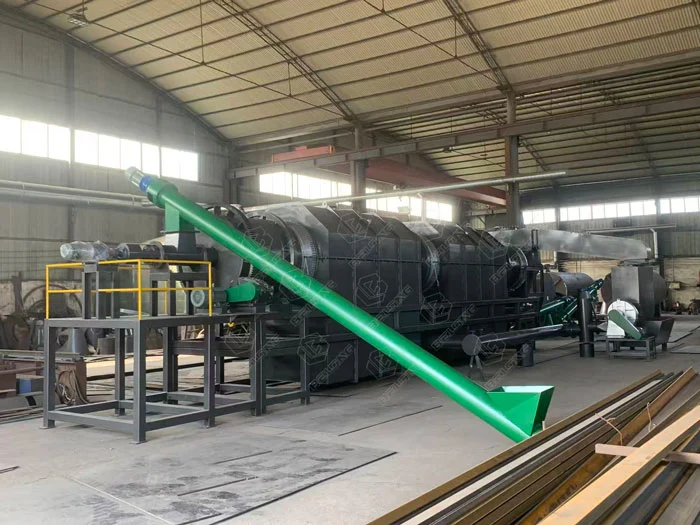
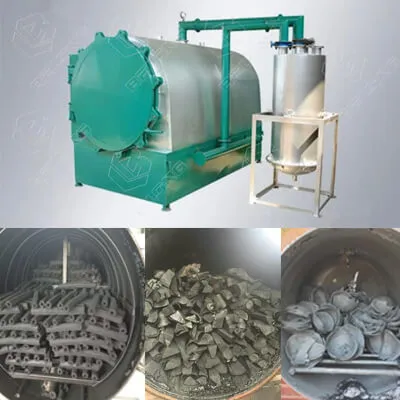
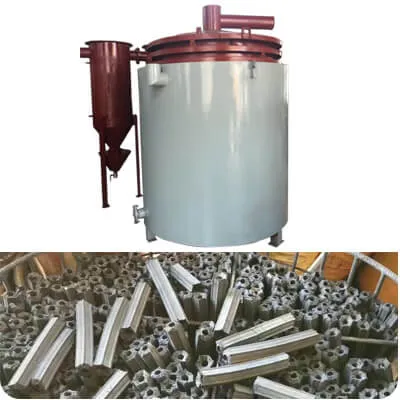
As a core piece of continuous pyrolysis equipment, the carbonization rotary kiln converts carbonaceous feedstocks into charcoal or biochar through high-temperature processing in an oxygen-depleted environment. Compared to the airflow carbonization furnace, its greatest features are non-stop operation, energy-efficient syngas recycling, and smokeless, eco-friendly performance. It is widely applied in biomass carbonization, activated carbon manufacturing, and solid waste treatment.
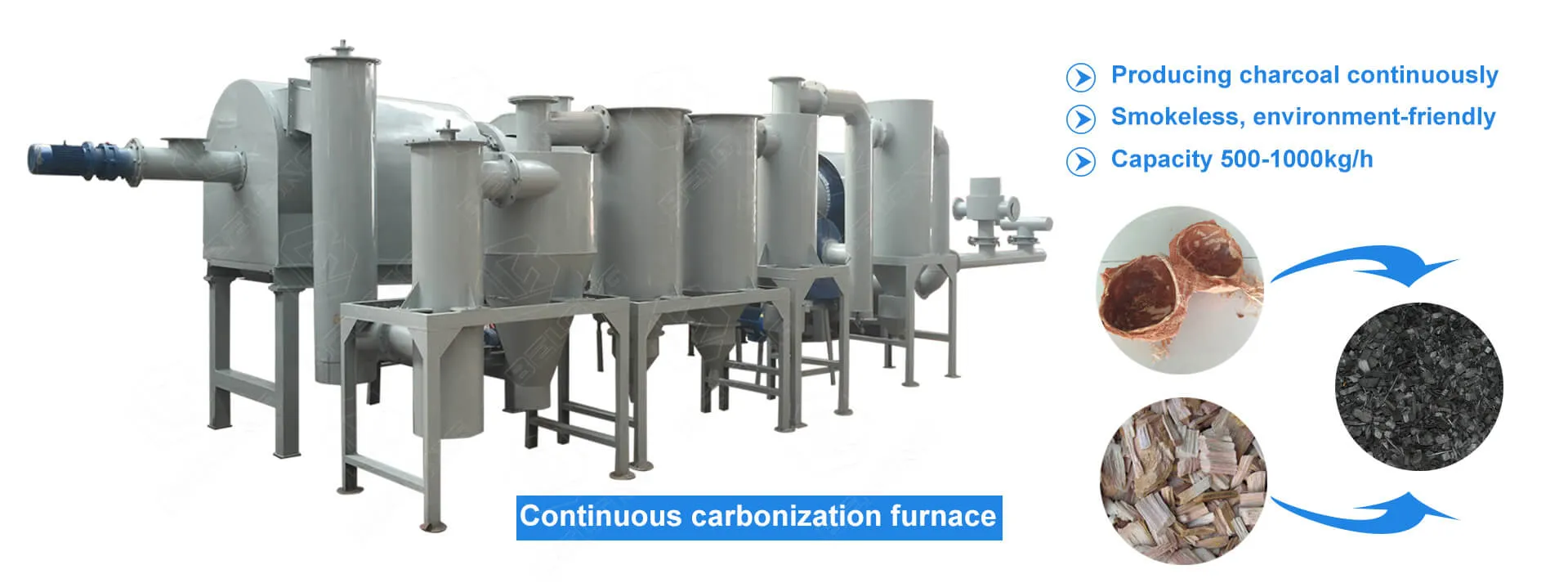
Structure of rotary carbonization kiln
The rotary carbonization furnace sets include the main kiln body, combustion heating system, smoke purification system, gasifier, conveyors, and an electric control cabinet, among other components. The thermal insulation material used for the main kiln body is silicate thermal insulation cotton, with a thickness of 200mm.
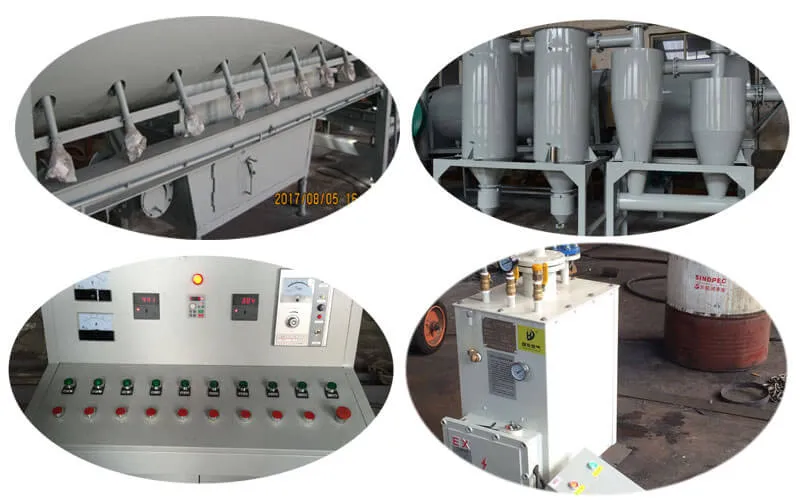
| Component | Function |
|---|---|
| Main Kiln Body | The core component of the entire equipment, it is a horizontally placed cylindrical shell with a slight inclination (generally 3°–5°). The shell is made of high-temperature-resistant alloy steel to withstand long-term operation at 300–1000°C, while the inner wall is lined with 150–250mm thick refractory insulation material (such as silicate ceramic fiber) to reduce heat loss and avoid shell deformation due to overheating. Inside the kiln, a set of evenly distributed lifting plates is welded; as the kiln rotates slowly (0.5–5 rpm), these plates continuously lift and scatter the materials, ensuring full contact with heat and uniform carbonization. |
| Driving System | It consists of a motor, reducer, and supporting roller assembly. The motor drives the reducer to adjust the rotation speed, and the supporting rollers support the heavy kiln body to realize stable rotation. A frequency conversion control module is configured to flexibly adjust the rotation speed according to different raw materials and carbonization requirements, thereby controlling the material residence time in the kiln. |
| Feeding & Discharging System | Feeding Unit: Equipped with a screw feeder or belt feeder, the adjustable feeding speed ensures a continuous and stable material supply matching the kiln’s processing capacity. Discharging Unit: A sealed cooling discharge machine is adopted. The high-temperature charcoal discharged from the kiln is cooled rapidly in a sealed environment to avoid re-oxidation, and then transported to the finished product area through a conveyor. |
| Heating & Combustion System | The continuous carbonization furnace employs an external heating method: the combustion chamber is located outside the kiln body, and heat is transferred to the inside of the kiln through the kiln wall, avoiding direct contact between the flame and the material. This system is equipped with a gas recovery device: the combustible gases produced during the carbonization process are purified and introduced into the combustion chamber as fuel, reducing energy costs. |
| Electrical Control System | It is the “brain” of the entire system, consisting of an electrical control cabinet, temperature sensors, and speed sensors. Operators can monitor key parameters such as furnace temperature, rotation speed, feeding speed, and gas flow rate through the electrical control system. The system has an automatic alarm function; when parameters exceed the set range, the system will sound an alarm and trigger corresponding protective measures to ensure safe operation. |
Requirements for materials in continuous carbonization
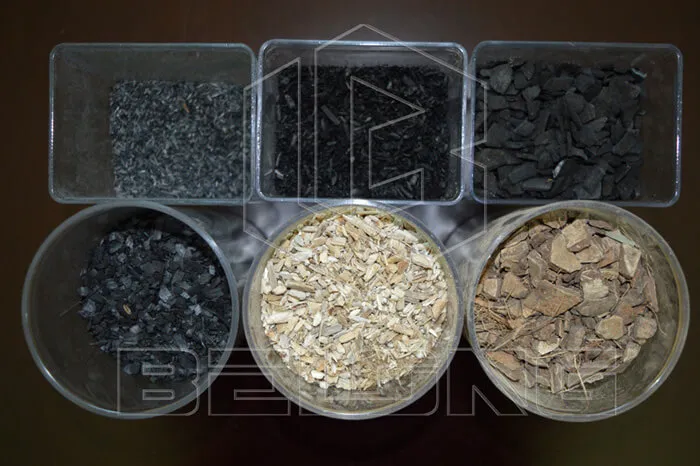
The rotary carbonization furnace is suitable for carbonizing coconut shells, wood chips, rice husks, bamboo chips, sunflower seed shells, palm kernel shells, etc.
To ensure complete carbonization, large raw materials need to be processed into 5mm< pieces < 5 cm before entering the carbonization machine. Meanwhile, the moisture content of the raw materials should preferably be < 30%, which ensures both the production efficiency of continuous carbonization and reduces fuel consumption during the carbonization process.
Brief description of the continuous carbonization production process
Preheating Phase
Connect the gasifier to the gas tank and heat the main kiln body using liquefied petroleum gas or natural gas.
Drying Phase
Once the internal temperature reaches the preset 200°C, begin feeding raw materials (e.g., wood chips, coconut shells). As the carbonization drum rotates, the materials are first dried to remove water vapor.
Pyrolysis Begins
The temperature inside the drum continues to rise. After the drying process, the materials undergo pyrolysis and produce flue gas, which contains combustible gases, dust, and other components. The flue gas is then routed to purification tanks for treatment; the separated combustible gas is delivered to the combustion zone at the bottom of the kiln for combustion.
Pyrolysis Begins
As more combustible gas is supplied to the combustion chamber, the flame intensity increases. At this point, operators can gradually reduce the gasifier’s load and shut it down completely. From this stage onward, the kiln relies solely on the self-generated gas for heating.
Continuous Carbonization Phase
Continuous material feeding and charcoal discharge can then be initiated, and the entire system will enter the continuous carbonization phase.
Shutdown Procedure
Since the continuous carbonization furnace operates continuously for generally 1-2 weeks after startup, the entire machine is in a hot state when it is shut down after prolonged high-temperature operation. If the drum is not rotated frequently, the drum’s centerline is prone to bending. Ensuring that the centerline does not bend is a very important and careful task and must not be neglected. Therefore, it is recommended that: within the first hour after shutdown, rotate the drum 1/2 turn every 1-5 minutes. Within the second hour after shutdown, rotate the drum 1/4 turn every 5-10 minutes. After shutdown, rotate the drum according to the above prescribed cycle until it is completely cooled.