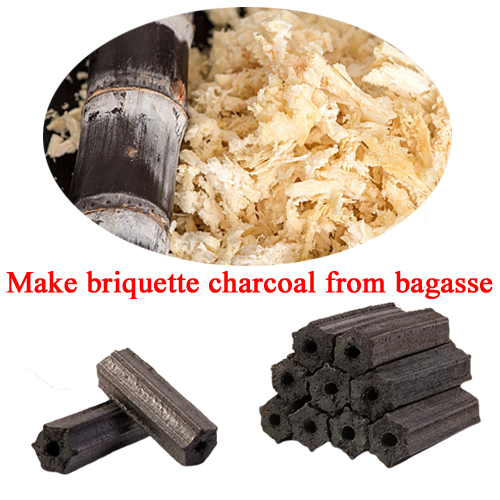
Sawdust briquette charcoal, also known as machine-made charcoal and, in some regions of Europe and Central Asia, as Pini-Kay charcoal, is made from wood sawdust and bamboo scraps through a forming-then-carbonizing process.
Charcoal Powder Rods, also known as extruded charcoal briquettes, are made from charcoal dust or crushed charcoal scraps, mixed with water and a binder, and then extruded using a charcoal rod machine.
These two types of charcoal look very similar, and many people, unaware of the differences, easily make mistakes when purchasing charcoal or charcoal-making equipment. This detailed comparison article can largely resolve this confusion.
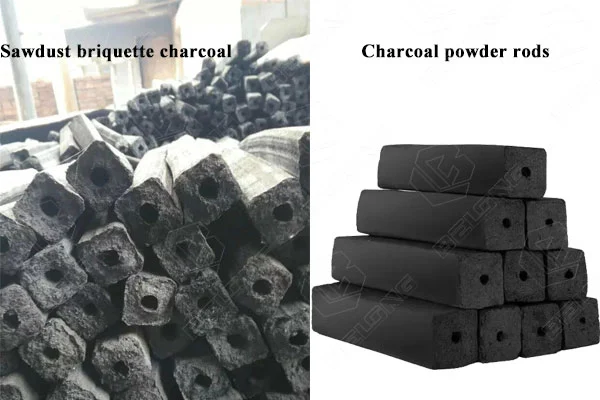
First, this comparison table can help you quickly and intuitively understand the differences between these two types of charcoal.
| Feature | Sawdust briquette charcoal | Charcoal Powder Rods |
|---|---|---|
| Raw material | Sawdust, bamboo scraps, etc | Charcoal dust, crushed charcoal |
| Adhesive | No need | Need |
| Appearance | Most of them have irregular lines, rough surfaces, are hard in texture, and produce a metallic sound when struck. | Regular shape and uniform size, the surface is straight and smooth, and the cut surface is flat. |
| Shape | Hexagonal/Quadrangular with a hollow core | Solid or hollow rods, various diameters |
| Process | Forming → Carbonizing (The “Dry” Way) | Carbonizing → Forming (The “Wet” Way) |
| Burning time | 4-6 hours | 1.5-3 hours |
| Calorific value | Extremely high, typically above 7500-8000 kcal/kg | Depending on the quality and purity of the charcoal powder, it is significantly lower than that of sawdust briquette charcoal |
| Ash content | Extremely low ash content ($3%-5%), with ash that is white or light brown. | The ash content is relatively high because the adhesive itself leaves inorganic residues after combustion. The ash is brown and not easily shaken off. |
| Smoke and odor | It burns with virtually no smoke or odor, and dripping oil does not easily ignite. | It depends on the quality of the adhesive. If the adhesive is of poor quality, it may have an odor or sparks. |
Next, we will provide a detailed explanation from several dimensions, including appearance comparison, raw materials and production processes, and combustion performance indicators, to help you understand the reasons for these differences.
Appearance comparison
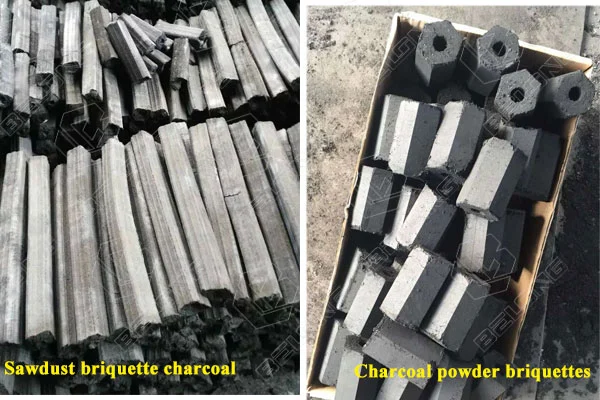
From the image comparison above, we can clearly see that sawdust briquette charcoal has a rougher surface, fewer straight lines, and an uneven cross-section. The holes in the center are also larger than those of charcoal powder sticks, and it’s evident that it has been subjected to high-temperature firing.
Charcoal powder rods, due to the inclusion of binders during production and automatic cutting, have a smoother surface, more uniform length, and neater cuts.
Differences in raw materials and production processes
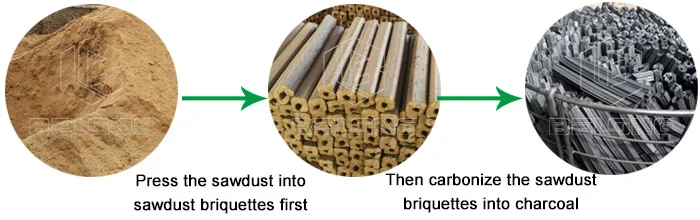
The raw materials for sawdust briquette charcoal typically include sawdust, bamboo powder, and similar materials. The raw materials need to be less than 5mm in size and have a moisture content below 12%. The raw materials are extruded into wood briquettes using a sawdust briquetting machine, and then carbonized at high temperatures to produce charcoal. No binders or water are added during the entire production process, and the final product is obtained through high-temperature carbonization. Therefore, sawdust briquettes charcoal has lower ash content, higher calorific value, and better quality.
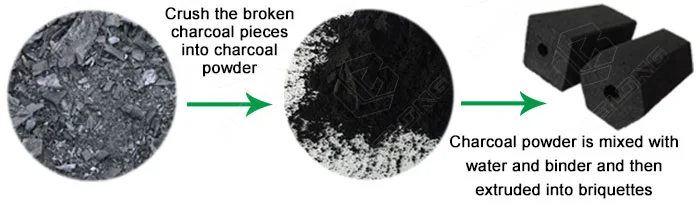
Charcoal powder rods are typically made from charcoal powder or crushed charcoal. The raw materials need to be crushed into charcoal powder first, then mixed evenly with water and binders. This mixture is then formed into charcoal powder rods using a charcoal briquettes extruder, and finally dried to obtain the final product. Therefore, charcoal powder rods have a higher moisture content and lower charcoal content, resulting in a lower calorific value and higher ash content.
Differences in combustion indicators
Both sawdust briquette charcoal and charcoal powder rods belong to biochar, but the core difference lies in the process sequence (sawdust briquette charcoal is shaped first and then carbonized, whereas charcoal powder rods are carbonized first and then shaped), resulting in differences in density, ignition, and combustion stability.
| Indicator | Sawdust briquette charcoal | Charcoal powder rod | The impact of differences |
|---|---|---|---|
| Higher calorific value | 28–32 MJ/kg (7000–7650 kcal/kg) | 27–30 MJ/kg (6500–7200 kcal/kg) | Machine-made charcoal has a 3%–8% higher heat output and a more stable fire |
| Fixed carbon | 75%–85% (High-quality ≥80%) | 70%–80% (High-quality ≤78%) | Machine-made charcoal has a 5%–10% higher thermal efficiency |
| Ash content | ≤3% (Excellent) / ≤5% (Qualified) | 4%–6% (common) / >8% (poor quality) | There is slightly more residue on the charcoal briquettes, and the furnace body requires slightly more frequent maintenance. |
| Water content | ≤5% (Excellent) / ≤8% (Qualified) | 6%–9% (common) / >10% (poor quality) | The charcoal briquettes have a high moisture content, making them slightly more difficult to ignite. |
| Volatile components | 8%–12% (High Quality) | 10%–15% (common) | The charcoal stick produced slightly more smoke and sparked more frequently. |
| Density | 1.1–1.4 g/cm³ (high density) | 0.8–1.1 g/cm³ (medium density) | Machine-made charcoal has a high burnability of 30%–50%. |
| Burning time | 4–6 h/kg (standard furnace) | 3–4.5 h/kg (same conditions) | Machine-made charcoal is less frequent and suitable for long-term roasting/heating. |
| Ignition difficulty | Easy to ignite, quick to set off | Longer ignition time required | Charcoal sticks require a combustion aid, which is slightly inconvenient for camping or home use. |